Small stories of great injustice: French director Marion Boé on the crisis of childhood and the indifference of the system in her film A Land of Paper
Small stories of great injustice: French director Marion Boé on the crisis of childhood and the indifference of the system in her film A Land of Paper
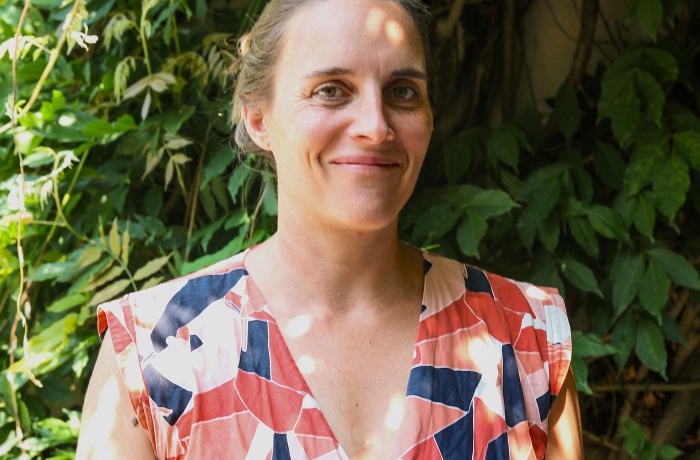
Marion, what spurred you to make a film about underage migrants in France?
At first, a friend told me about it, who was working with unaccompanied minors in the city of Quimper, in western France.
At first, I was glad to hear that these children were being welcomed and cared for by the child protection services. But later, as I talked to social workers and saw these teenagers on the streets, I realised that things were much more complicated. And that care for them was catastrophically lacking. Another social worker told me about Mélanie, a lawyer who helps these children. When we met in person, I immediately understood that it was through her story that I could show the full complexity of the system.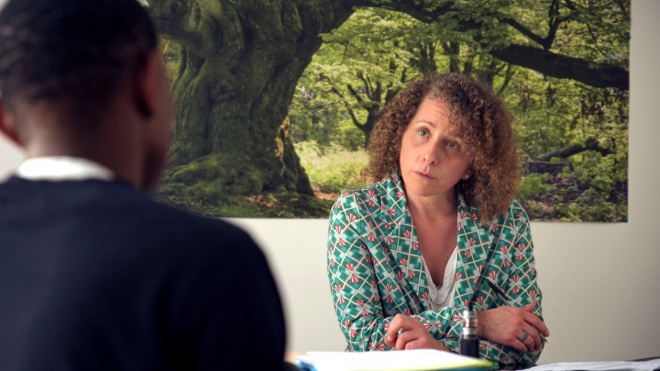 Photo: still from the film A Land of Paper
When you decided to make the film, what was the most important: to show the problem, the protagonists, or to change the system itself?
I wanted to show the difficult situation these teenagers find themselves in. Because most people in France don’t even know that these children are supposed to be placed under the care of social services.
They have no idea what these kids go through. And that without lawyers, they are practically defenseless.
I wanted to tell this story to all of France, and give these teenagers a voice.
How do French viewers and the international audience respond to A Land of Paper?
The French audience is surprised, sometimes even shocked. They begin to realise that justice in France is far from perfect.
But they also feel a desire to act, to talk about it on a local level, to make their own contribution.
Abroad, the reactions were very emotional. By the way, the protagonists themselves attended the first screening. They were very proud to have shared their experiences, and some of the now-adult protagonists came to tell people how their lives had changed for the better — thanks to Mélanie. It was incredibly moving.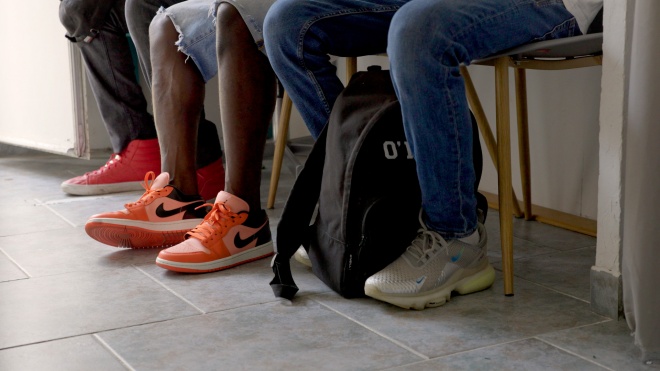 Photo: still from the film A Land of Paper
How did Mélanie herself respond when she saw the film?
It wasn’t easy for her — seeing herself on screen. But she’s glad that the film shows both her work and the struggles of these children.
Mélanie has devoted herself entirely to this cause. For her, it’s important that cinema can help spread this understanding.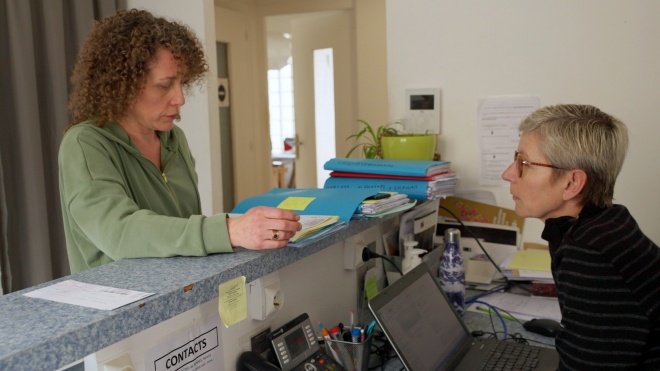 Photo: still from the film A Land of Paper
While working on the film, you mentioned your own childhood. How has France changed since then?
Now I’m more aware of what’s happening in the world. And I can see that the situation of migrants is getting worse, that racism is growing. Maybe before, we just didn’t talk about it out loud, but now people openly express their hatred, and that frightens me.
What do you fear most when it comes to this issue?
I’m frightened by the growing influence of far-right and fascist sentiments in many countries across Europe and the United States.
But at the same time, I see people engaged in humanitarian work, helping others — and that, of course, gives me hope.
Why did you decide to become a documentary filmmaker?
Even as a child, I used to film little videos, I dreamed of cinema. When I was 14, I met director René Vautier, who in the 1970s made films against colonialism, particularly in Algeria. That encounter had a great impact on me. I realized that, like him, I wanted to make films that have meaning and influence.
Being a documentary filmmaker is not an easy profession. How do you find balance between the pain of the topics you film and your own life?
I think filming is my way of taking action when I’m angry about injustice.
I enjoy meeting strong people, telling stories about solidarity and about ordinary people doing great things.
It gives me a sense that I’m not just watching, I’m actually making a difference.
Have you ever been to Ukraine?
No, unfortunately not. But when I learned about the Russian invasion three years ago, I was very angry and confused. I didn’t expect the war to last this long. I can’t imagine how you live with it every day. It’s very hard. I don’t know how to stop Putin, but my heart is with you.
A Land of Paper will be screened in many Ukrainian cities, even those close to the frontline. What would you like to say to the audiences in Ukraine?
It’s a great honor for me that, even in such difficult circumstances, Ukrainians are interested in a story from France. It means that we are all united by a shared commitment to human rights.
My film is about hope, about the struggle for one’s rights and for life itself.
I hope it inspires Ukrainian audiences to keep fighting — for themselves, for their country, and for the future.
The 22nd Travelling Docudays UA is held with the financial support of the European Union, the Embassy of Sweden in Ukraine, and International Media Support. The opinions, conclusions or recommendations do not necessarily correspond to the views of the European Union, the governments or charities of these countries. Responsibility for the content of the publication lies solely on its authors.