Parallels in Life: Travelling Docudays UA in Kherson Oblast
Parallels in Life: Travelling Docudays UA in Kherson Oblast

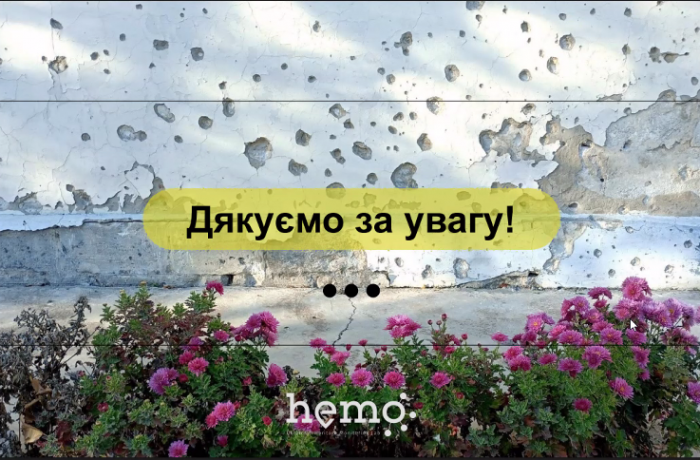
Why did the audience’s reaction on 20 October at the Beryslav Community Hub in Velyka Oleksandrivka prompt the organisers to “adjust” the programme? And what do the flowers planted beside the shrapnel-damaged facade of Vysokopillia Gymnasium have to do with the theme of the 23rd Travelling Docudays UA?
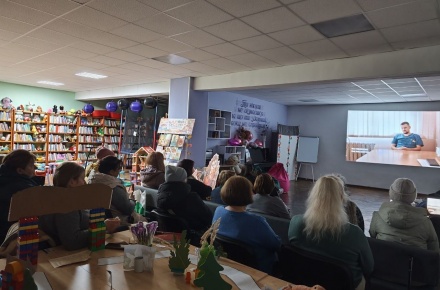
On Tuesday, 20 October, the Beryslav Community Hub in Velyka Oleksandrivka hosted its first-ever screening of the documentary Celtic Utopia as part of Travelling Docudays UA. The screening was followed by a discussion, “Decolonising Memory”, featuring invited experts. Both events were held in a hybrid format, with participants attending in person and online.

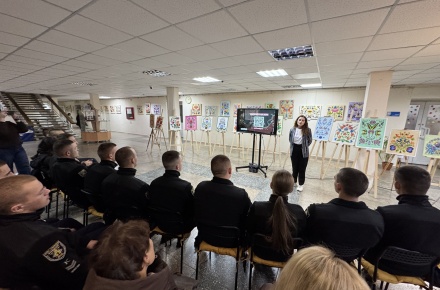
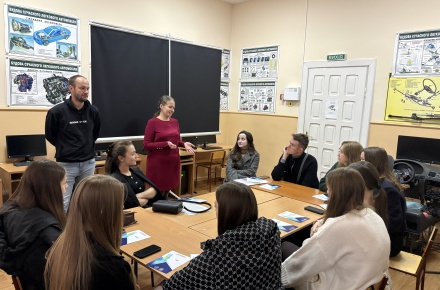
Photo: Discussion participants.
When the online participants had watched the film and returned to the Hub for the discussion, they discovered that a lively conversation about decolonising memory was already under way.
Just like us
According to Olesia Chavurska, the event moderator and senior lawyer at the East SOS Charitable Foundation, those in the room were so struck by the previously unfamiliar history of the Irish people, who had fought for their identity despite colonial oppression, that they could not contain their emotions and began commenting on what they were seeing on screen straight away.
“The reaction was so lively that we even had to pause the screening from time to time to let people share their thoughts,” Olesia said.
Aliona, one of the participants at the Hub, shared some of the “parallels” she and others had drawn while watching the film:
“We saw a lot of similarities between our people and the Irish. For example, our country is divided into east and west, and it turns out that Ireland is similarly divided into north and south. Their language is forbidden, but they preserve it in their songs so they won’t forget it. For hundreds of years, the people have maintained their identity, and continue to do so, despite pressure not only from England but also from the Church. It all sounds so much like our people and Russia…”

Photo: Aliona Yevko, event participant, and moderator Olesia Chavurska.
During the human rights discussion, invited expert Liza Yevsieyeva, an architect, co-founder of the Nova Kakhovka Cultural Heritage Preservation Society NGO and coordinator of cultural heritage loss documentation at the Ukrainian Heritage Monitoring Lab, shared her vital experience documenting war crimes against Ukrainian culture.
“Russia is destroying the language of our architecture because it bears witness to our resilience”
Liza Yevsieyeva spoke about the preservation and restoration of immovable cultural heritage:
Today, I coordinate cultural heritage loss documentation at the Ukrainian Heritage Monitoring Lab NGO. Since the beginning of the full-scale invasion, our team has been documenting damage to immovable heritage sites: individual buildings, ensembles of historic structures and cultural landscapes.
We do this to support justice and restoration. Our goal is to ensure that not a single building destroyed by Russia goes undocumented, and that we let them get away with absolutely nothing they are doing to our culture. For me, as someone from Nova Kakhovka, a city that was completely occupied within the first hours of the invasion and has already lost a tremendous number of heritage sites, this is deeply personal. Together with the New Kakhovka Cultural Heritage Preservation Society, our entire community spent more than ten years working on these sites: researching them, bringing them to light and bringing people together to rescue them from oblivion.

Photo: Liza Yevsieyeva, architect, co-founder of the Nova Kakhovka Cultural Heritage Preservation Society NGO and coordinator of cultural heritage loss documentation at the Ukrainian Heritage Monitoring Lab.
“Every generation inscribes its identity into the space where it lives”
Celtic Utopia explores language in a particularly skilful way. Not just the language we speak — Ukrainian or Irish — and not just songs, either, but how every generation “inscribes” its identity into the world around it. Even when that identity falls silent, it still exists. It is expressed through the language of architecture, landscape and the environment we inhabit.
Today, Russia is destroying and erasing this language precisely because it embodies resilience. An architect, historian or local history researcher can always read a building or a village’s cultural landscape to discover who founded it and who lived there. Cossack crosses on graves, the remains of churches, traditional buildings and even old barns that have survived in the south of Ukraine can tell an architect a great deal about who actually settled these lands: Ukrainians, Mennonites, Jewish settlers or members of other communities. But if all of this is erased by bombing and then cleared away by bulldozers, the language that bears witness to our identity will be lost forever.
That is why we are trying to document these losses. The Office of the Prosecutor General of Ukraine and other partner organisations are already using our materials to establish evidence of each act of destruction for future international court proceedings.
“The right to heritage is an inalienable right of every one of us, not an exclusive club for super-experts”
“I want to emphasise why we, as an NGO, have the right to do this. Many people do not understand how ordinary citizens can document anything. In fact, the right to cultural heritage is an inalienable right of every one of us. Without the voice of every member of a community, proving these crimes will be extremely difficult,” says Liza Yevsieyeva.
It is worth mentioning the Faro Convention (the Council of Europe Framework Convention on the Value of Cultural Heritage for Society), which Ukraine ratified in 2013. It shifted the focus from protecting material objects alone to recognising people’s right to engage with their heritage. The convention changed how the world views cultural heritage: decisions about its value are no longer the sole preserve of so-called “super-experts” in exclusive, elite circles, who might decide that only sites such as the Kyiv Pechersk Lavra or Notre-Dame de Paris are worth protecting. No — each of us can do this where we live, in the places we love, whether a city or a village.
This might mean advocating for a cultural centre built in the 1950s by Ukrainian artist-architects. Even if it is not a masterpiece of world architecture, perhaps your grandmother sang there, your grandfather danced there, and old photographs of your town hang on its walls. That alone makes it an extremely important place for nurturing a community’s identity and understanding who we are.
“Heritage gives us the dignity and continuity that the enemy is trying to erase today”

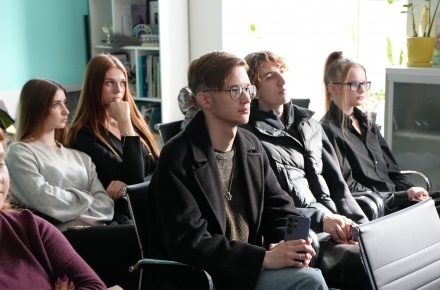
Photo: Speakers at the discussion on preserving cultural heritage.
Preserving memory is a very long process. It is like planting a tree and tending to it for years before it bears fruit. The children with whom we began talking about Nova Kakhovka’s stone embroidery ten years ago have now been scattered across the world by the war. Yet Nova Kakhovka remains a vivid, unique point of reference for them.
They are no longer ashamed to say they are from southern Ukraine. They proudly say, “We’re from Nova Kakhovka. It’s a beautiful city, and I can show it to you.” This is the dignity that heritage gives us. And it is precisely this continuity that Russia is trying to erase today.
Thank you for your attention — or, “Simple Structures”
During her presentation, Liza Yevsieyeva shared part of a slideshow she uses at other speaking engagements. She always ends with the same slide: flowers growing in front of a wall damaged by shelling, with the words “Thank you for your attention” written above them (cover photo).
The photograph shows the shrapnel-damaged facade of a gymnasium in Vysokopillia. It was taken in 2024 during expeditions by the Ukrainian Heritage Monitoring Lab NGO to document cultural heritage losses, before restoration of the building was even being discussed. Yet after the area was liberated, local residents planted flowers beside it, on land that had only just been cleared of mines.
When Liza shows this slide during her presentations, she emphasises that the words are not a thank-you to the speaker for their attention. They are a message of gratitude from our cultural heritage for our collective efforts to listen to its voice.
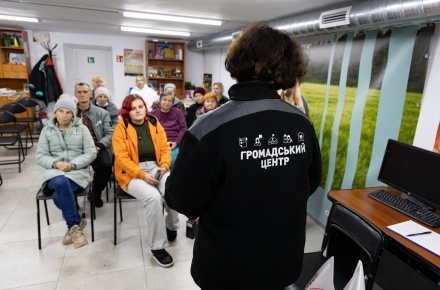
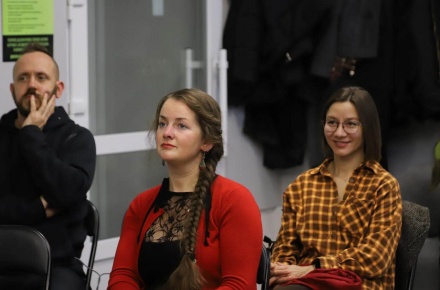
Photo: Discussion participants.
Nataliya Bimbiraite, head of the Legal Space Information and Resource Centre NGO, shared another reason why the photograph had moved her:
“Friends, this photograph beautifully illustrates the theme of this year’s Travelling Festival — ‘Simple Structures’. It speaks of the resilience and profound love Ukrainians have for their heritage, expressed through seemingly simple acts such as planting flowers under shelling.”
Text by Iryna Ukhvarina.
Photos by Aliona Yevko and Oleksiy Zvarych.
The event was organised by the regional partner of Travelling Docudays UA in Kherson Oblast, the Legal Space Information and Resource Centre NGO, in cooperation with Beryslav City Council, the Kherson regional branch of the Committee of Voters of Ukraine and the East SOS Charitable Foundation. Media partners: Suspilne Broadcasting, Hromadske Radio, HURT and Vhoru.
The 23rd Travelling Docudays UA is held with the financial support of the European Union, the Embassy of Sweden in Ukraine and the International Renaissance Foundation. The views, conclusions and recommendations expressed do not necessarily reflect those of the European Union, the governments or charitable organisations of these countries. The authors of this publication bear sole responsibility for its content.